Update on Shivaji Nagar’s Masjid project

May 15th, 2013 by urbzman

masjid
A mosque in the Shivaji Nagar area that we have been asked to redesign. Michele Bonino (studio Marc) standing in front.

For over a year, URBZ has been documenting the construction process and providing design inputs for many small houses built in Shivaji Nagar (Govandi, Mumbai). Shivaji Nagar is a slum notified area, which is known for having both, very low development index records, and an extremely upwardly mobile population and a booming local construction market.

Most of the 10 x 15 feet houses we documented and got involved with, were built by Pankaj Gupta and Wasim Khan, two of the most respected building contractors in the area. Every project became a space for discussion and dialogue about structures and design between architects, contractors and homeowners.

Wasim and Pankaj are from the neighbourhood and have learned the practice of construction while working with other contractors. Construction expertise has been communicated and spread among generations of contractors and via peer- to peer learning, which sees high standards of construction.

There are inevitably many challenges. Maximum flexibility and use value, along with a safe, beautiful and solid house reflecting the client’s identity is the usual brief given to local contractors. The speed of construction is also important for families that need to stay with friends or family while the project is ongoing. The ground is shallow making and the monsoon runs high. Plots are of various shapes and sizes and the clients’ needs are just as diverse. Houses are highly customized and often built in stages. The complexity of the task makes collaboration with designers and other construction specialists all the more relevant.

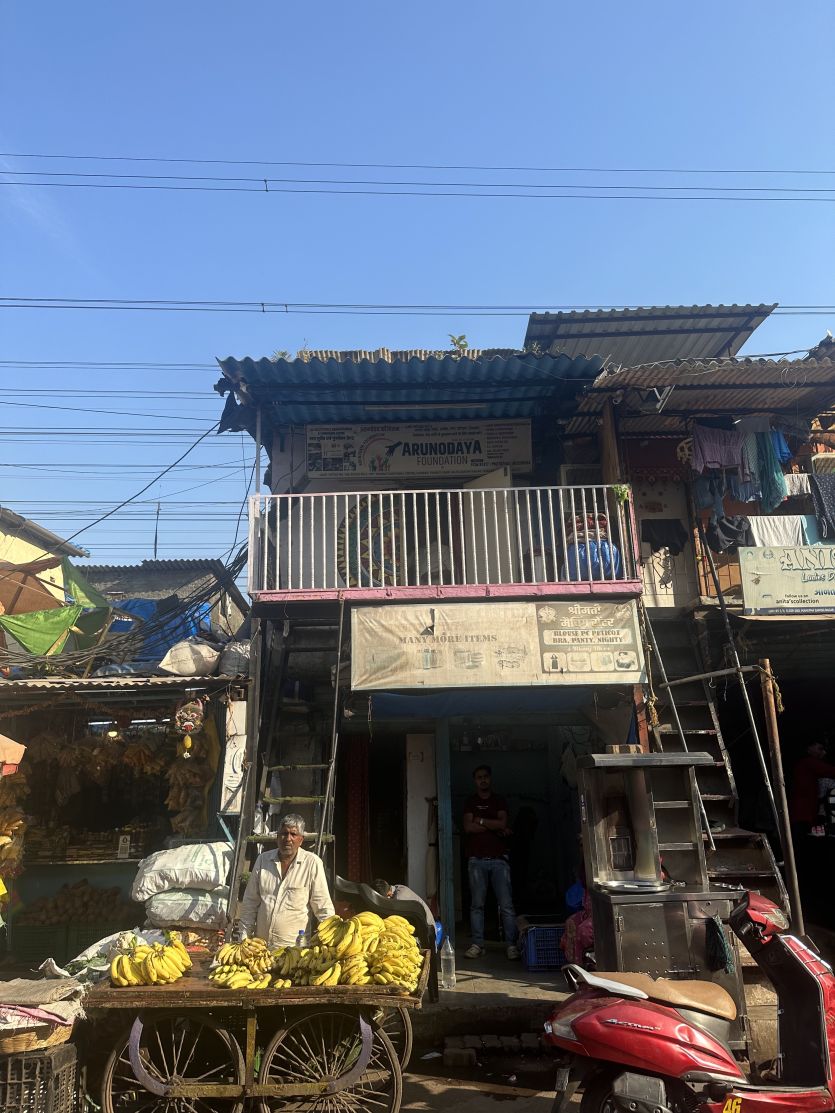
Existing-view-1
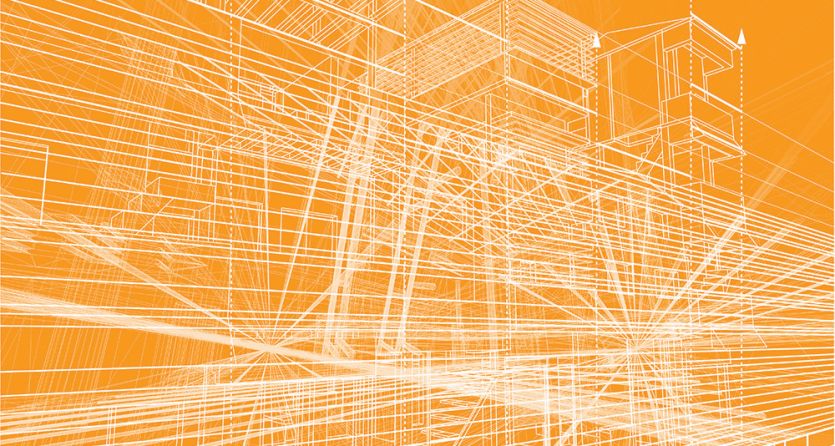
Volumetric view of existing mosque and street.

Subhash Mukerjee and Michele Bonino from Studio Marc in Italy came on board, entering the discussion, enriching the process with their expertise in dealing with tight spaces, small areas, details, improvising structures and being culturally sensitive. They felt these could be applied in some way on the small family houses that were being constructed in large numbers in Shivaji Nagar. Together, URBZ and Studio Marc formed a new entity dedicated to small construction called “Marc Hood”.

The project started out with small interventions. These were often needed during the process of construction itself. Just as we started understanding the construction process and were getting involved in small projects, a big one came our way, to which we could not say no. Irfan Khan, a young, respected local politician and Secretary of the trust of a Mosque named Jamat Ahle Sunat Masjid & Madrasa Faizan-E-Raza asked us to help with the design of a mosque!

The new mosque will be built on the site of a 30 years old mosque nestled in the dense middle section of the neighbourhood.

masjid2
Kids at the madrasa.

Like most mosques (and other religious institutions) in the area, it started off as a temporary structure. In the beginning it was mainly used as a Madrasa, where young Muslim boys and girls learnt lessons from the Quran. It grew in size incrementally and now has hundreds of members. The entrance is flanked by a string of shops on both sides – this is the income generating mechanism to keep up the maintenance of the mosque.  It presently just has one large room separated by a wall to demarcate the prayer space and a tank for religious ablutions called the Vazu Khana.

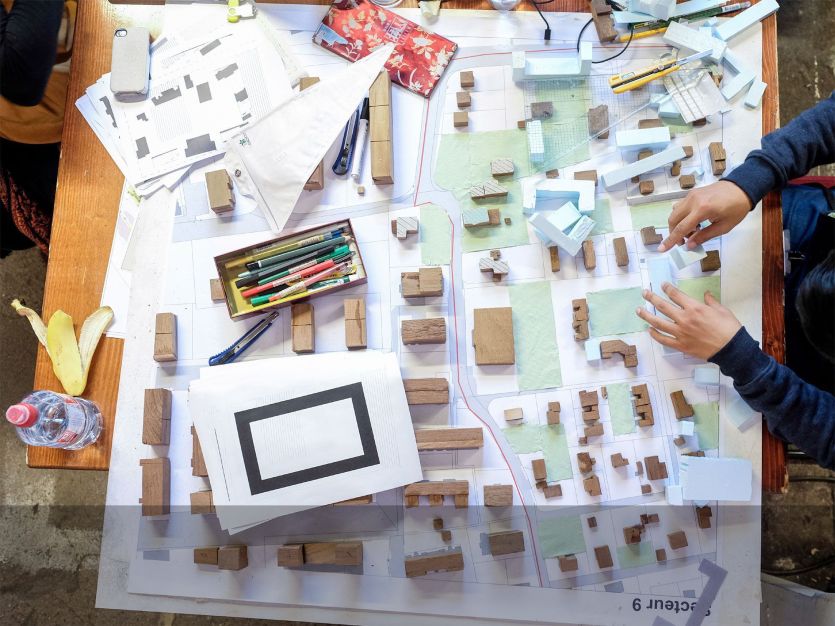
Irfan became central to the design discussions and to connect us to the community. The brief (which took definite shape after several meetings and discussions) indicated the need to develop an iconic structure, that kept in mind the space and site restrictions, community aesthetics and aspirations. It had to be flexible and adaptable, essential features working within the existing dynamic situation with potentially multiple future functions and many more users. Phase by phase drawings and renderings were generated with the aim of developing a body of plans and proposals that could help generate funds and kick start the project. Irfan is confident that the funds necessary for the construction can be raised locally.
committee
Masoom Moitra and Rahul Srivastava discussing the design with the mosque committee.

Subsequently, for the next six months, regular visits focused on documenting existing conditions, and initiating discussions with present users of the space and the neighbourhoods surrounding it. Soon an understanding developed about the imagination of the mosque in the minds of the people who pray there as well as the priests and trustees who lead prayers. This was communicated internally to the whole team which regularly shared the design inputs back with the community.
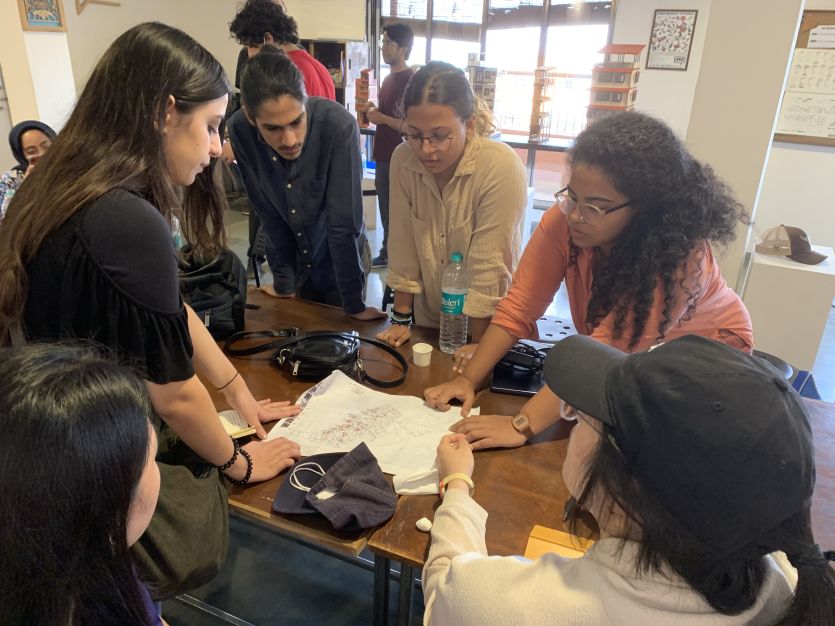
Once the discussions helped fine-tune the designs, these were presented back to the mosque committee. Subsequent to the approval discussions moved to the actual execution of the structure. The complex process of working with drawings and developing paper work started. The team is joined by a local civil engineer who helped, to understand the actual site conditions like soil stability, load-bearing abilities of the structure, as well as issues of management of the structure on site.

The best part of the project is that we all understand very well that the design we are proposing now will evolve dramatically and probably become something else altogether in the execution phase. We intent to work directly with contractors and the committee throughout the construction period. One of the main learning from our involvement with contractors in Shivaji Nagar is that design cannot be reduced to desk work. It is only in the action and by being on site that an architect makes it alive.

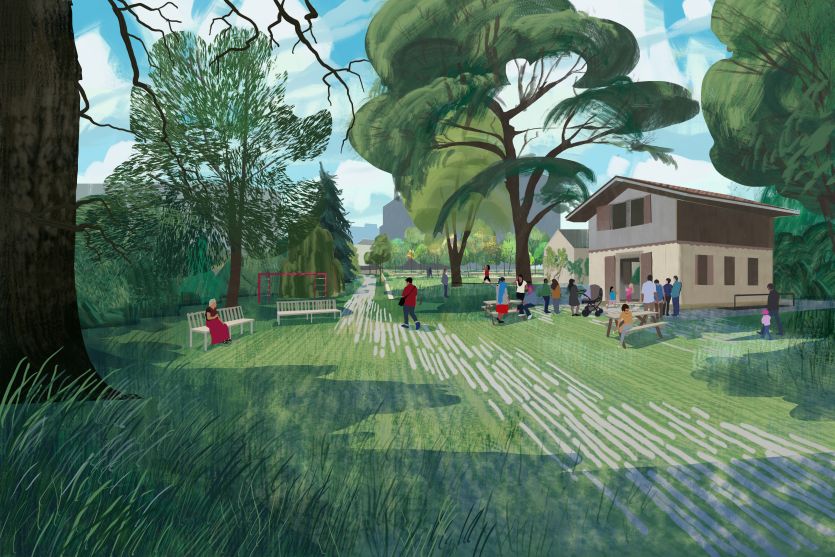
proposeddeisgn
Street view of Marc Hood’s proposed design for the mosque. Click for more views.

Post by Masoom Moitra, Rahul Srivastava and Matias Echanove

Warli in Dharavi

May 9th, 2013 by Sytse


Image of big city life in Warli style: Sion road, Dharavi

The presence of tribal communities in the Mumbai Metropolital region is not so well-known. Warlis, Kathkaris, Thakkars, Bhils are some of the many forest linked communities that are as integral to the peripheral landscape of the city as are industries and concrete developments. The fact that Mumbai encompasses both, the most densely populated neighbourhoods in the world, along with a natural tropical forest within its municipal limits, is also a counter-intuitive complement to this story.

While Warli art has become as gentrified as an art gallery in a heritage urban precinct, the reality it represents is hugely significant. Tribal communities in India represent a relatively independent section of a caste-based society. Their loss of control over forest lands, which traditionally provided them the economic basis of social independence had a huge impact on their lives. Today all statistics on poverty are actually framed by a community based angle and the scheduled tribes constitute one of the lowest indicators in terms of economic status. And yet, they are at the forefront of political resistance in different parts of the country. Within the larger narrative of tribal India, the potency of even gentrified, over-exposed art forms from the Warli community tell something about the complexity of social life in India.

Warli art has historically been showcased on the walls of their homes. The stylized images are powerful expressions, and their simplicity only enhances the meanings conveyed. Bodies that are slightly bent express motion, arms and legs may consist of only a few lines but communicate much more.   The paintings are a way of telling stories and depict scenes of everyday life, mythological stories, events expected in the coming year, or just entertainment. The Warli style of painting is said to date back many centuries and may have migrated all the way from Africa. Today, many people have moved to the city of Mumbai and scenes of everyday life in this dense city are very different from the old paintings.


Warli paintings representing daily life in the village.

Later this year, probably in September, we are planning a one week event in which young people can learn Warli art. Warli artists will come and teach children, teenagers, and students how to tell stories of their own life in attractive drawings and paintings, a bit like in cartoons. At the end of the week, the paintings will be brought together in an exhibition which will show everyday life in Dharavi as seen by today’s young generation.

The event is about connecting art and everyday life. Warli painting will be connected to the city, and youngsters will learn an art that once was part of the life of their own family. It is about making connections between the city and tribal, the present and tradition.

It goes without saying that the exhibition will be opened with a great celebration in which all participants can proudly present their achievements to their friends, families, and the community. Although the event is primarily educational, the artists will have a good time too as Dharavi is an extraordinary place to make paintings of.


Cybercafe and city-style furniture

The images in this post are made by artists of the Adivasi Sahaj Shikshan Pariwar Center in Masvan Palghar. Their art work is a source of income from which the center can finance its activities: education, healthcare support, social forestry and farming, and women empowerment.

The event will be organised in a close cooperation of local schools, Warli artists, URBZ, and the Swiss Federal Institute of Technology in Lausanne. Contact Sytse de Maat for more information.

Post by Sytse de Maat, PhD student in architecture at the Swiss Federal Institute of Technology in Lausanne, and Urbzman.

Workshop: The Future of Murbad Village

May 3rd, 2013 by shardul

India has experienced unprecedented growth in the past one or two decades. However, “New India”, liberalized, globalized and “shining”, has yet to define its model and the values it embodies. Becoming a megapower, home to some of the wealthiest individuals and companies in the world, cannot be an end in itself. If the “new” in “New India” is to mean anything then we have to make the effort to imagine what it could be. As of now the “new” seems to merely be about copying and supersizing the same old economic wisdoms that have produced unsustainable, polarized and crisis prone regimes in the West.

The age structure of India, where nearly 50% of the population is under 24 years old makes it clear that the aspirations and decisions of the youth will shape the country’s future in dramatic ways. In these times of transition when India is redefining itself, and asserting its newfound position in the world, we must look at ourselves anew, drawing as much from our roots as our collective imagination.

Youth are leaving villages and moving to the city –sometimes coming back with new means and ambitions; in the city the same youth gets absorbed as workforce in the booming private sector, where they seek to climb the economic and social ladder. Youth wants it all, here and now, fast and furious. They want what they perceive as Western standards for themselves. They are aware of their country’s problems, and either feel contempt and a need to run away. Or they want to make a change for themselves from within the system.

What they often forget in the process is the tremendous potential that lies deep in the civilization they are part of. Indigenous systems in homegrown villages and neighbourhoods for instance, which have survived multiple layers of colonization, modernization and globalization, could be a source of inspiration for new development principles altogether.

The development we are thinking of is based on small, thoughtful, sustainable solutions, rather than huge, “time changing”, “mega” stream of thinking; on individuals and communities, rather than corporations, departments and agencies. It is the kind of development that could ensure a bountiful of resources for generations to come. It is the kind of development that takes as its measure individual happiness rather than the GDP of the country.

Because we seem to have left them behind as we rushed for the gold, it has becomes necessary to expose these persistent and widespread (yet undermined and threatened) systems all over again. This is why we are committed to a long enduring search for the buried organizational structures that still follow common-sensesical economy principles, and which are connected human needs and mother earth’s means. We do this by documenting the lifestyle and architecture of existing indigenous villages. We propose to go back to the village and explore its intense and simple livelihood principles. Based on our observation, we brainstorm on the best way to take some of these principles to scale in their own small ways.

The research program called “The Umbilical Connection” is a first step in this direction. For a month we will research and document the village of Murbad near Dahanu (a few hours from Mumbai), and speculate on the future the village and on the relationship between the village and urbanization. This program is intended as a discovery more than as a teaching experience. The conductors of the workshop (Design Jatra) are themselves not equipped with full knowledge of the village’s systems. We commit ourselves to this research along with the participants and villagers. We therefore do not have a preset agenda and objective. We hope to engage with the village, and hope to become ourselves actors in its development.
The workshop starts with a detailed documentation of sustainable local practices, which enrich the life of the village. The second step is a documentation of two structures in the village, which are built according to different construction principles. The third step is to use the knowledge gathered in the first and the second steps to co-produce with the villagers a twenty-year vision for the village. The fourth and the final step is set our vision in motion. It can be anything from a landscape element, to an architectural intervention, to planting a tree, or organizing a small exhibition.

The workshop is open to anyone who wishes to commit to the journey we expect to begin. This means developing a deep relationship with the village of Murbad, and thus it will enable the participant to become a part of the village now and in the future.

The workshop is be held from 1st of May to 5th of June. It is a come in and out workshop which means that participants can join the workshop at whichever stage they want. However, we would really prefer that participants join with the journey for as long as possible and as far as possible.

For more information about the workshop, contact Shardul Patil via this page.

Shardul Patil is a student at Academy of Architecture in Mumbai and a member of URBZ. Pratik Dhanmer, a practicing architect and fellow member of URBZ is a co-organizer of the workshop and co-author of this post.

The village outside

April 24th, 2013 by urbzman


View of Paspoli village from the Renaissance Hotel in Powai.

Take a slice of Mumbai city, thin or thick, narrow or broad, and you will find a bit of everything – tightly juxtaposed and cosily nestled.

A high-tech office space next to a dense exotic bazaar, with people sharing services and personnel are not trapped in contrasting typologies but cross-wired intricately into each other.

Imagining different worlds co-existing with cold indifference is a tempting interpretation to make about Mumbai – until you start paying attention to the way in which people traverse firewalls all the time. 

At first glance, the view from a permanently fastened glass window of a five-star hotel, in a recently developed northern part of the city, has potential to create a lot of medieval drama.

The view looks down landscaped gardens, bounded by compound walls. Just beyond the boundary, clutching a small hill, the average client of the hotel, sees a typical homegrown neighbourhood, which she has been conditioned to believe is a slum. The slum of global urbania – cesspools of crime and dirt and all that is gone wrong with cities today.

The proximity and contrast is disconcerting.

It is easy for her imagination to edit real and cinematic memory and visualize hordes of angry dwellers from the slums jumping across the water pipes and compound walls to dive straight into her room. She is suddenly relieved about the permanently shut window and well-guarded gates surrounding the hotel.

The client is here on a conference, which the hotel specializes in. Her accompanying colleague stays in a room with a more expensive view. It overlooks a lake surrounded by a skyline that seems to be a live projection of Hong Kong or Singapore. In reality it is made up of expensive real estate projects built on land reserved for low-income housing.

powai-lake-view
View of Powai Lake from the Renaissance Hotel.

When the two hotel residents take a break from the conference to buy gifts, they go there. They can be forgiven for believing that they have indeed traversed into a low-income housing complex, notwithstanding the Manhattan high prices of the neighbourhood. 

The same cross wiring of services and personnel, along with shabby maintenance, produce that effect. This expensive piece of real estate now has the same glorious messiness and general shabbiness that the city as a whole seems to revel in.


Hiranandani towers: Up-market residences built on land originally reserved for low income housing.

They realize that the neighbourhood on the other side of the lake is meant to be visually consumed, from a distance, through the coffee shop of their hotel, rather than at close-quarters. When they ride up an escalator, they glimpse similar homegrown neighbourhoods all over the hillsides immediately behind the bizarre Greco-roman facades of the expensive buildings.  Once again the proximity and contrast is disconcerting. It feels like living in one city but seeing another urban landscape everywhere around.

Back in the safe confines of the hotel, the two ruminate on their conference – on sustainable urbanism. The irony-rich complexities of this city, the rich hotel and the theme of the conference are not lost on them. 

Like many of the other participants, the two feel the need to speak about the world outside the hotel.  Urban poverty and slums become one of the main themes of the discussions happening on the margins of the conference, sometimes late into the night.

One evening they decide to continue their conversations over cigarettes while exploring the gardens and the grounds. Within minutes security guards zoom down and insist they go back to their rooms or to the walled-in 24 hour coffee shop, since all outdoor areas have to be shut at night for security reasons. 

This bit of information increases her anxiety – security from what? However, thanks to the few drinks, they decide to walk around the hotel and soon find themselves by the back gate of the buildings, from where all the daily hospitality necessities, including drinking water, are delivered. 

Over the gate they see the same neighbourhood she had seen from the window.

Paspoli-map
Map showing Paspoli village at the centre, tucked in between walled compounds. Click to enlarge.

Upon request, a polite guard opens the gate and lets them out. They find a little stairway that leads to a small footbridge that climbs over four huge water pipes leading them to the other side. 

Her first feelings are one of trepidation. But her instincts and the encouraging words of her friend, who has visited the city many time before, egg her on. Sure enough, she realises her fears are totally unwarranted.

They are welcomed by light, sound, music and people. The neighbourhood doesn’t seem to be asleep yet although it is well past midnight. They move closer to a blue structure with a wheel exactly like the one on the Indian flag. People are busy decorating the structure in and out. Kids, speaking in impeccable English, approach them asking where they come from.

Their smiles become wider when they realise the two gate-crashers are guests from the hotel. 

They point out people from the crowd who work there. Apparently about a third of the working adult population, are employed by that establishment as well as other hotels in the vicinity. She recognizes a waiter that served them breakfast in the morning and they exchange smiles.

When asked what are the festivities about, the kids inform her that it is in preparation for Dr. Ambedkars birthday and they are all going to go on a march as part of the celebrations. 

Suddenly the world seems different. She knows who Dr. Ambedkar is. The draughtsman of the Indian constitution and beloved leader of the Dalit communities of India, historically referred to, with prejudice, as untouchables, and now a vibrant, upwardly mobile part of Indian society, a society that may or may not have got over its hang ups about caste.

Her friend points out that he and Dr. Ambedkar went to the same universities abroad, London school of Economics and Columbia University. 

That night, from the vantage point of the settlement, the whole neighbourhood looks different. Her hotel looms on the horizon, a gigantic structure, looking like a castle atop a hill. She laughs on realizing that the strict but abstract security measures could not have been targeted at this settlement for sure. Since the two are clearly enmeshed with people coming in and out constantly.

Flickr Video
Dr. Ambedkar’s birthday celebration at Paspoli
.

They respond to the invitation of a resident and come back the next day to the same place. After participating in the Ambedkar Birth anniversary march for sometime, they return to the neighbourhood to clearly see its physical and historical identity as a village that existed decades before the grand institutions surrounding it were even conceived. As if to make the point, some cattle wander around, herded by a young boy, coming from the lake nearby. The village is historically connected to a vast natural habitat, which has slowly been closed off to the public, though locals still find their way through.


Inside Paspoli village.


Farmhouse at the top of the village (Click to enlarge and see more photos).

An engineering college occupies another huge chunk of land at the back of the village. Its compounds are heavily gated and porous at the same time. They meet a man just outside the college wall in his small farmhouse. The house, complete with a cowshed on one side and a well on the other, is strikingly reminiscent of similar farms you see in villages of Uttar Pradesh. He points to a back door that leads into the engineering campus informing them that employees living in the village regularly use it. They enter the campus through this small side gate and are absorbed in another world altogether.

Lush greenery and monumental structures populated by self-important engineers and official looking academics with ballpoint pens tucked away in their shirt pockets. Before they can fully process what’s happening, security guards demand their identification and insist they must register at the main entrance. 

Feeling unwelcome they leave the campus and walk back to the hotel through the village.

Back onto the footbridge, that connects the village to the hotel, the two have the strange feeling of having walked through a secret passageway, of having broken through a firewall. One that exists between worlds that shares more than their inhabitants care to acknowledge. 

One wonders if that small bridge could not be turned into a honourable link between two quintessentially Mumbai urban forms: the globalized high-rise and the homegrown neighbourhood. Perhaps recognizing this co-dependency is also an important path to sustainable urbanism.


Bridge from Renaissance Hotel to Paspoli village.

Click here to see photo album of Paspoli village

Click here to see photo album of Dr. Ambedkar’s birthday celebration in Paspoli.

Laura Alonso, Bharat Gangurde, Shyam Kanle, Bo Tang, Geeta Mehta, Matias Echanove and Rahul Srivastava have contributed to this post.

Ataide’s Home – Workshop in Paraisopolis, Sao Paulo

April 17th, 2013 by urbzman

Ataide Caetite is a successful pedreiero (builder/contractor) from Paraisopolis, a large and dense homegrown neighbourhood in Sao Paulo. He has built over 70 homes in the area and in the countryside. With a heavy reliance on his own individual labour, along with a close association and support of his clients, each home of his is a testimony to his dedication to the craft of construction. This workshop is a tribute to his dynamic work.

Marcella, Gabriela, Fernando and Valeria have been preparing the workshop for a few months now. It revolves around the refurbishment  and construction of two floors up of Ataídes’ house. The workshop starts this weekend and goes on till the 25th of May! We are excited and looking forward to what will be a very enriching experience.

This workshop invites the student-architect to learn about building houses with local residents, which is relevant to their local needs. It goes beyond a conventional lesson about construction techniques. The workshop aims at generating a practical understanding of the dynamics of this important part of Sao Paulo. We can no longer deny the diversity of urban forms, construction techniques and lifestyles even within such a modernist city.

This is a collaborative project bringing together residents, professionals and students. They will observe, understand, debate, teach and learn with each other. The workshop will be joined by women from the residents’ association, as well as engineering and architecture students and faculty from the Escola da Cidade.

Paraisópolis, as well as many other communities in São Paulo, are neighborhoods that have not been well understood and recognized. The workshop, organized by URBZ Brazil aims at  providing an opportunity for students to learn more about urban life, a practice that we believe will become increasingly applicable to the future of this country and and its major cities. And of course to produce the best possible house for Ataide!

Ataide
Ataide Caetite