Shapeshifters and Apparitions
Authors


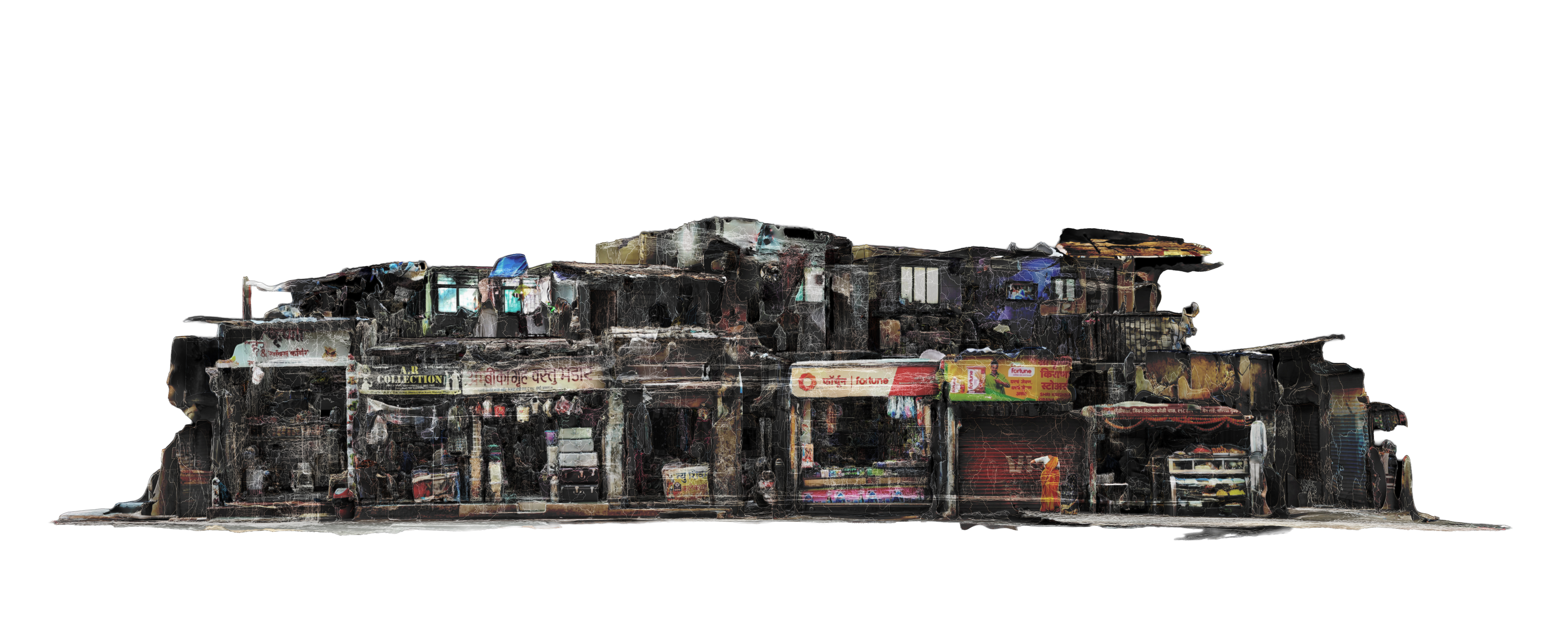
Shapeshifters and Apparitions
Authors
Shapeshifters and Apparitions: A Week Spent Measuring Ramesh Koli’s House
The following text recounts Paarth and Abhay’s experience measuring a plot of land owned by Ramesh Koli and his family. The plot includes a house and 7 shops that face the street. The family hopes to redevelop the plot with urbz.
As you may find, our experience as architecture students, dealing mostly with conventional structures, didn’t prepare us for the surfaces and shapes we would encounter on the site. Our understanding of ‘space’ was shattered and rebuilt every day, layered, attached, and stretched to fit a number of other dimensions not included in our curriculum.
Day 1: Our first task was to observe the site from an aerial view and register the site outline with a definition. We got this aerial perspective easily, as it was from the urbz office balcony. We understood the site's layout to consist of two distinct halves: a residential section and a commercial section. We also noticed that there was a workshop on the second floor of the home (Ramesh Koli’s).
Day 2: We started with the residential half, but were unfamiliar with the home's layout. We quickly realised that this first set of measurements would only be to familiarise ourselves with the layout and structure of the house. We learned that initially, only the house was in place, and subsequently, the houses in the front were rented out to make shops. This led to the site extending immediately adjacent to the main road. Our first set of measurements was inaccurate, and our methodology for calculating lengths and diagonals was inconsistent. We used a laser tool to measure longer distances and a tape measure to calculate smaller distances. These tools are easy to use when the construction is simple and undergoes minimal change over time. This home, meanwhile, is an object of immense architectural complexity, with evolving meanings and, therefore, built forms. What chance does a puny tape measure stand? After collecting the measurements overlaid on a previously drawn site outline (by the survey officials), we found many irregular shapes and angles that were the source of head-throbbing confusions. Later in the day, Paarth drafted a first version of the plans, and there were still many measurements that 1. Made no sense in relation to the survey drawings and 2. Made no sense in and of themselves. We thought, however, that this was a good start, and our methodology would improve over time.
Day 3: We took a jab at measuring the commercial half - 4 shops and a sliver - on the ground level. Yet again, this came with new challenges: the shops were filled to the brim with all kinds of products, packed incredibly efficiently, and there were so many movements, i.e., of the shop’s customers and the shopkeeper. One of the shopkeepers, who wasn’t seeing much footfall at the time, agreed to help us with the measurements. It was a clothing store filled with a wide variety of items. It was late afternoon, and a heavy lunch had made the three of us (Eesha, Paarth, and me) impatient. So many conflicting measurements. There is a narrow gully between the two central shops that produces an incredibly complex shape, with so many shifts in the walls and other architectural elements. We took down the measurements nonetheless and went back to the office, hoping for better results. It seems that ‘Less is more’ in the measurement-of-complex-spaces game. Our stress only increased; we had three sets of measurements that disputed each other’s claims to validity, and it was highly likely that none were truly making such a claim. We had been outright inaccurate this whole time. We called it off that day and would try something different the next.
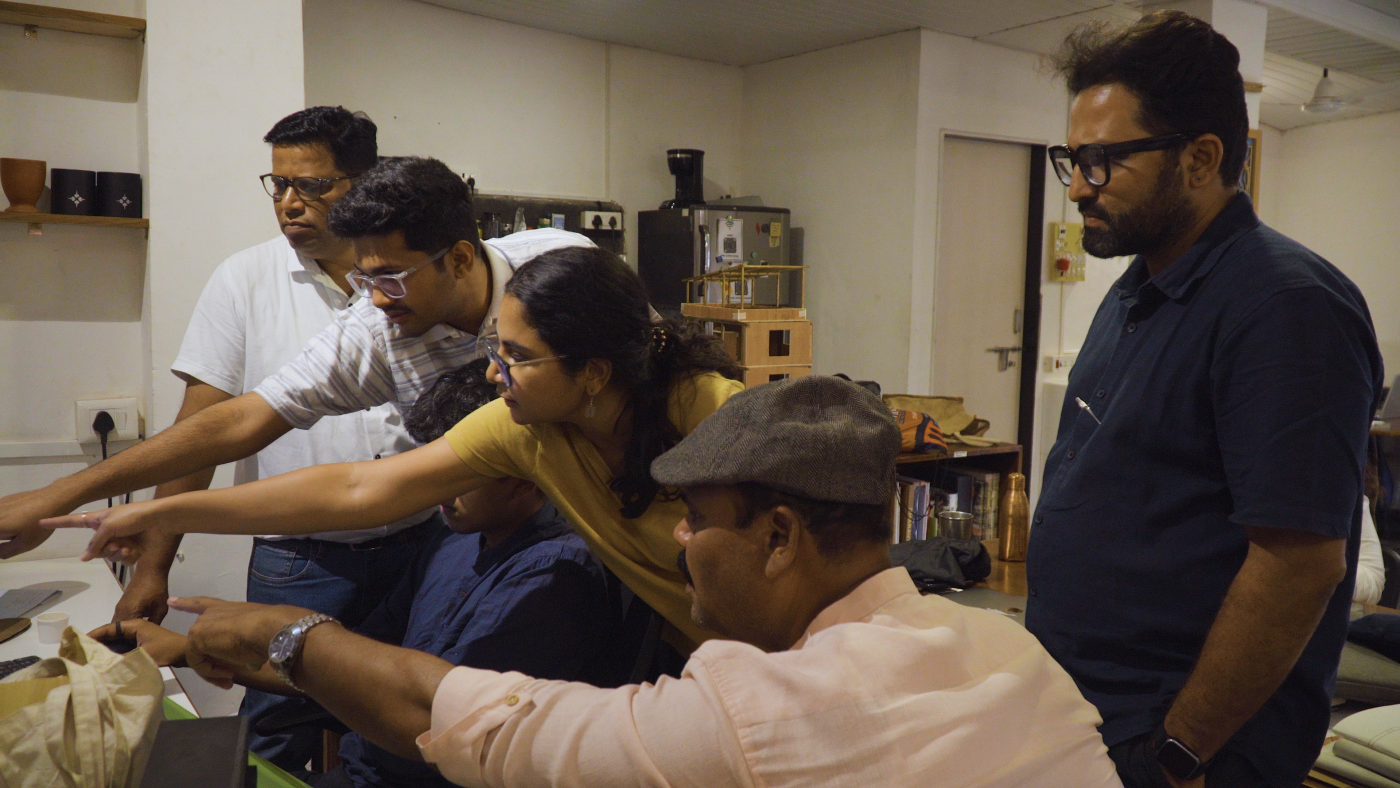
Day 4: We went to Aunty’s house late in the afternoon, when the Jamaat hall was having some sort of event/function. There were many unused chairs piled up next to the hall, which is also the current entrance of Aunty’s home. I brought my laptop with me, pulled up one of the chairs, and sat down with it on my lap. Our methodology today would be to draft and measure simultaneously to ensure the success of the space’s geometrical ontology. Paarth would take every measurement several times, despite the inconveniences of bending under clotheslines, reaching over jutting-out plaster, and dodging the resident cat. Paarth endured. And added to our set of tools was Paarth’s mighty phone, which could now calculate the angles between the walls. More often than not, the walls are not at right angles to each other. And get this: have inconsistent angles that play cruel tricks on your mind. Paarth endured. And so did I, albeit after 2-minute bouts of transcendental laughter on recognising Paarth’s bewilderment. We spent an hour measuring a 100 sq ft courtyard, taking note of every angle, every length, every diagonal, and every relation to other reference points. After many iterations, we arrived at a reasonably cohesive draft of the courtyard with accurate measurements. But we thought it was a successful day; we had found a methodology that works.
Day 5: What we call the “long-room” came next. We had previously measured this room and confidently began the measurements. It has a bed, a couple of chairs, a TV, a fish tank, and a few tables of varying sizes. It even had two cupboards that took up an entire section of the wall. Paarth measured the angle on the corner and the angle ahead of the cupboard to ensure that this straight-seeming wall was indeed so. His phone then showed us a difference of 11 degrees. No, no, this can’t be real, what my eyes tell me is linear and curving so much? It must be something to do with the light. We broke up the wall into small segments, as we had done the day before. The light-green wall does magnificent things. It bends and dips simultaneously, and this change is reflected vertically as well. The fish tank refracts and disperses light, creating a fresco-like effect on the wall. In some sections, when Paarth taps the wall, crumbling plaster dust falls and brushes onto me. The biology of the wall reveals itself to us, but making it all the more incomprehensible, and I am no surgeon. This is no ordinary place, I began to realise, the room is swirling with illusion. Whether you choose to believe me or discard me as some sort of wannabe magical-realist, hear what Paarth had to say about the next day. Anyway, we fumbled around for another half hour, having ended with the same progress as the day before.
I spent the weekend back home in Bengaluru, ridding myself of this Mumbai magic. I did normal things that didn’t confound my relationship with reality.
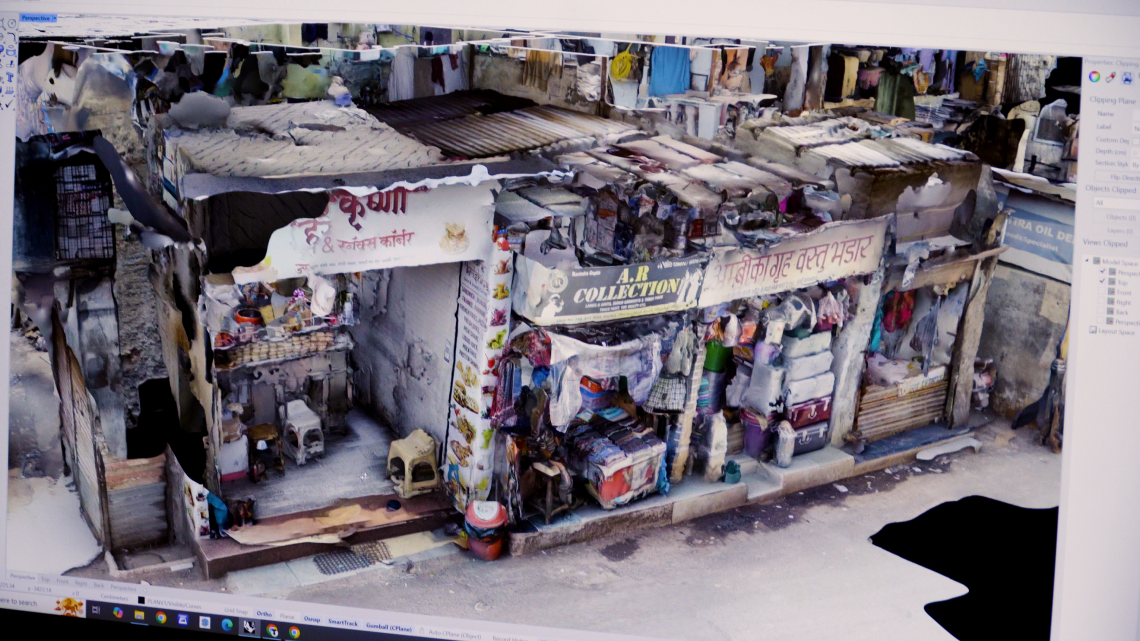
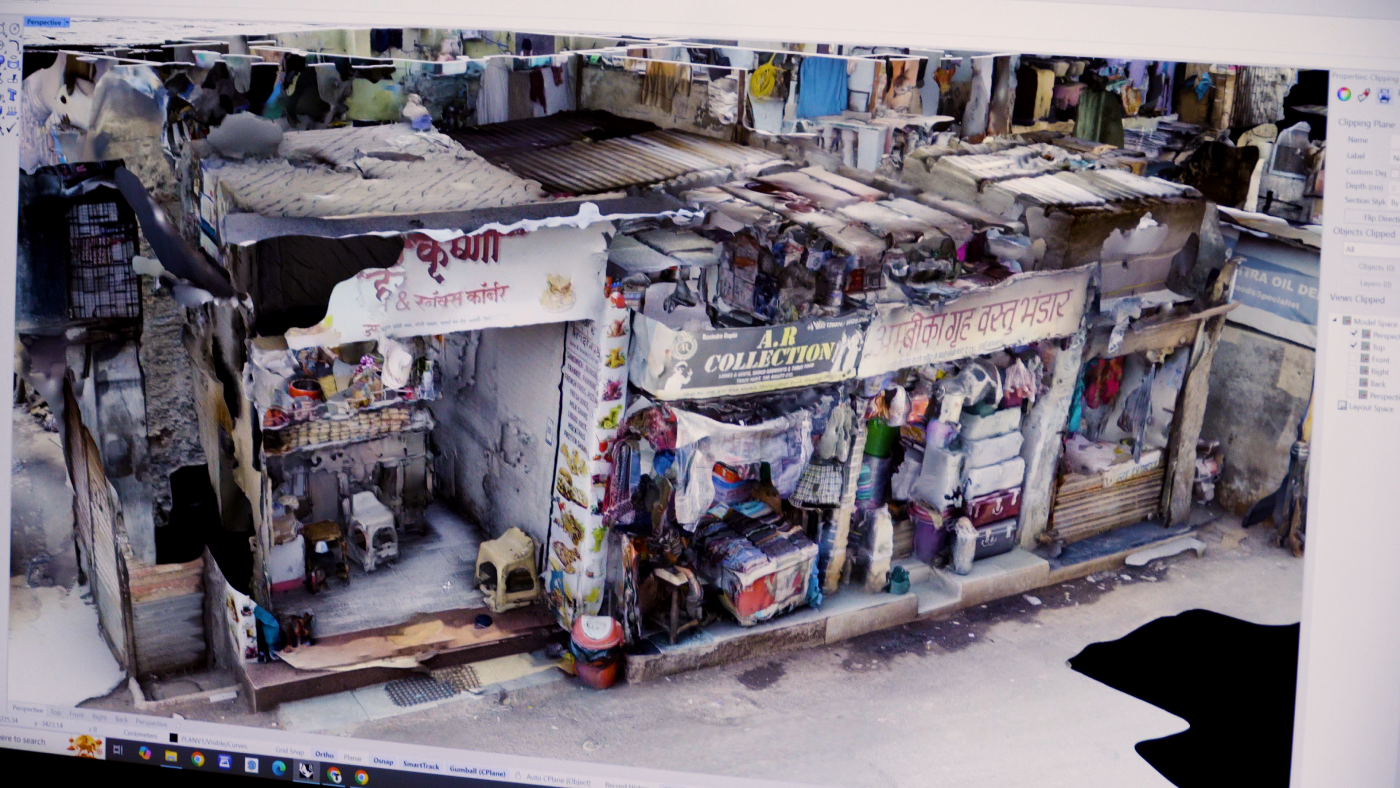
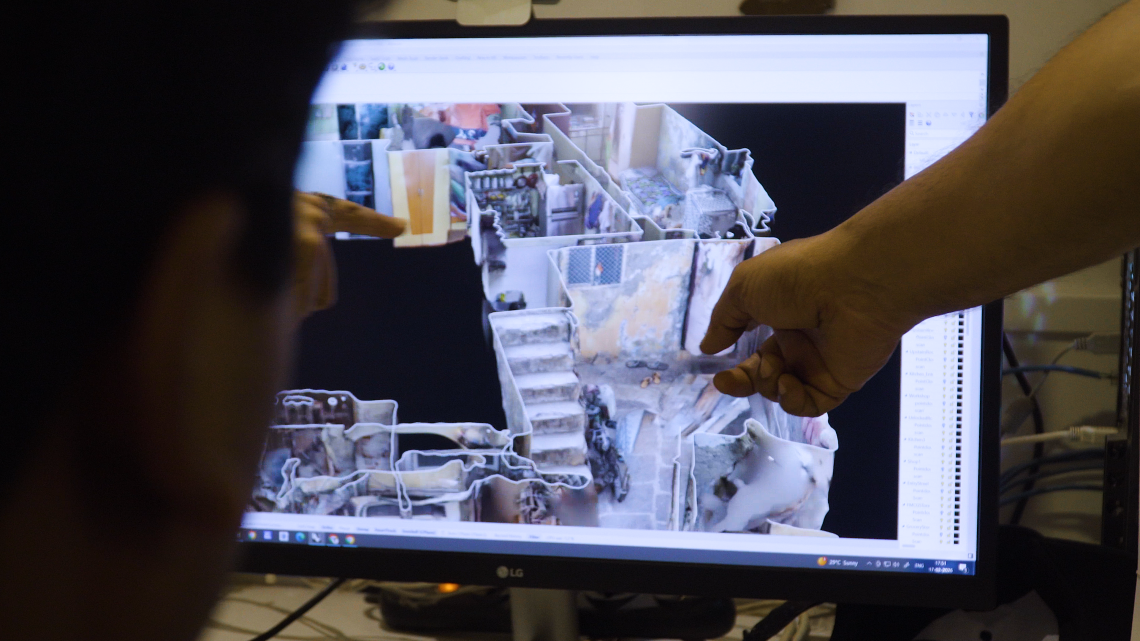
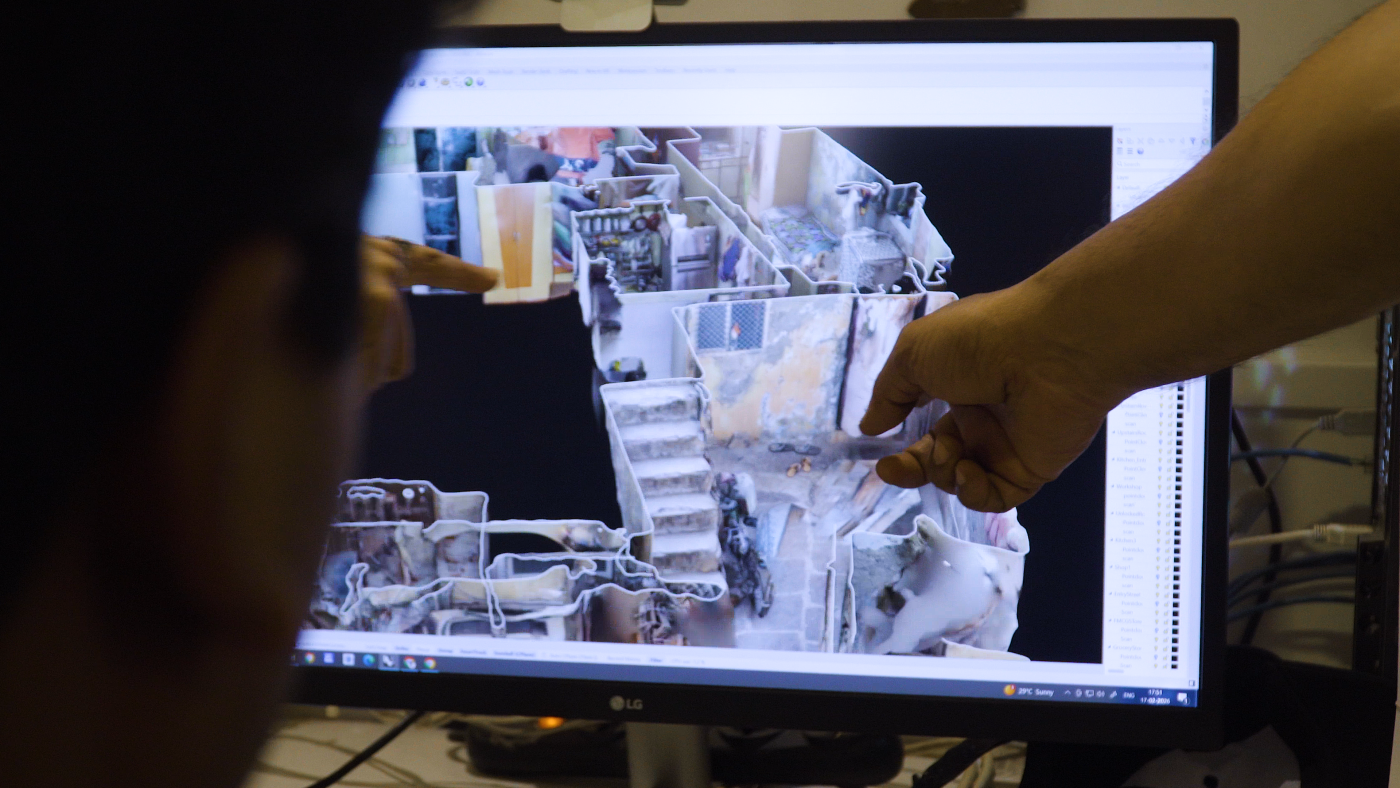
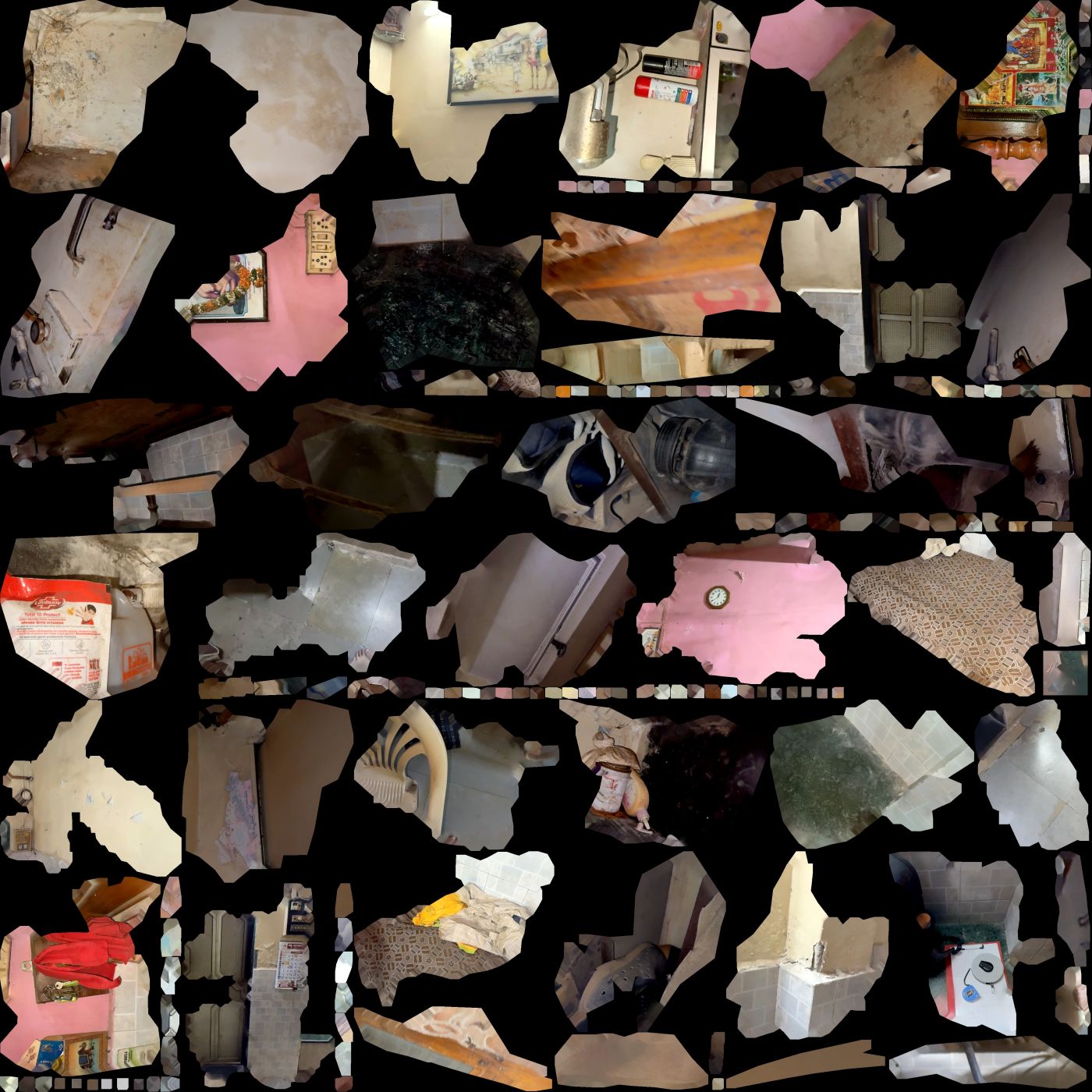
Day 6: We had discussed LiDAR scanning for a while (never seriously) and thought it would be cool to experiment with for representational drawings. We convinced Paarth to get a LiDAR scanning app and test it out in the office. There's now a 3D file of me lounging on a sofa, when I should've been working. But the scan was successful, and renewed our hope in taking on the herculean task ahead.
Paarth’s phone mightier than ever began the LIDAR scan of the courtyard. And soon enough, room after room, we were assembling a collection of meshes that I would then stitch together on digital software. Attached to their living room, a storage room-cum-bedroom is most easily identified by the incessant squeakings and gulpings of the rodent mating seasons. Paarth, scared of only two things, dogs and rats, handed his phone to me. Not that I am some sort of pied piper either, nonetheless, he had done so much already; why not sub in for him? Only one room to go in the residential half, so we left it for the next day.
Day 7 (Paarth): Fresh off our success the previous day, when we managed a comprehensive 3D LiDAR scan of the long room, the courtyard, and the street leading from the Dharavi main road to the house, we set an ambitious goal for our current session. We decided to map the entire interior of the house, which included the living area, kitchen, adjacent bathroom, and bedroom. Still adapting to the scanner on my second day, I knew the work would demand a great deal of patience. We planned to allocate about twenty minutes to each section.
I began methodically, tracing every corner of the room. Operating the device felt like an acrobatic routine. I contorted my body into awkward angles, desperate to capture the entire space in one take, knowing a redo would drain whatever energy I had left. After finishing the living room, I moved towards the kitchen, starting with the adjacent bathroom before tackling the kitchen storage. The storage area proved particularly difficult; stacks of kitchen storage- grocery, sacks of grains, etc. blocked the LiDAR's lasers from reaching the walls, requiring extra effort and maneuvering to accurately map the room's spatial extents.
Then, things took a supernatural turn. The room looked perfectly normal to the naked eye, but the camera feed began to flicker, overlaid with a dense digital disturbance. A low, vibrating hum echoed in the background. Abhay and I assumed it was a nearby generator, though we couldn't figure out why it would cause such severe interference with the scan. My mind drifted to a conversation I had overheard the day before: the landlady told our colleague Bharat that this particular kitchen had remained untouched since her sister-in-law, its primary user, passed away. Naturally, my brain began connecting our technical glitch to the tragic local lore.
The situation escalated a few moments later as I swept the phone near the kitchen counter. The LiDAR suddenly began generating a point mesh around what appeared to be a distinctly human figure hovering at the edge of the counter. Before I could fully process what I was seeing, the phone rapidly overheated, the app froze, and the device abruptly shut down, even though 80% of the battery remained.
When I finally managed to turn the phone back on, my worst fear was confirmed: the entire scan was lost. Frustrated and exhausted after half an hour of wasted effort, we had to rethink our strategy. Assuming the combined scan was simply too heavy for the phone's processor to handle, we decided to map each room individually.
I spent the next thirty minutes carefully rescanning the living room. This time, it saved successfully, giving us our first real win of the day. Relieved, I took a brief break before heading into the bedroom-storage area. A few minutes into scanning, the unmistakable squeaking of rats began to echo around me. The noise quickly multiplied, growing louder and more frantic. Abhay guessed we had disturbed the mating rats. Unsettled by the sheer volume of the noise, I handed the scanner to Abhay, who kindly stepped in to finish the room. By the time he successfully saved the file, it was lunchtime, and he headed back to the office.
I volunteered to stay behind and finish the kitchen, since it was the last item on our checklist for the day. Alone in the quiet house, I began my sweeping motions again, hoping the technology would cooperate this time. Out of nowhere, the bathroom door eerily slammed shut. Abhay had specifically propped it wide open, resting it firmly against the wall so it wouldn't become an obstacle. There was no wind, no draft, and no reason for the heavy door to swing closed on its own.
Pushing past my rising unease, I finished the kitchen scan as quickly as I could. I packed up the gear, called it a day on site, and hurried back to the office, eager to share the day's absurd and surreal events with the rest of the team over lunch.
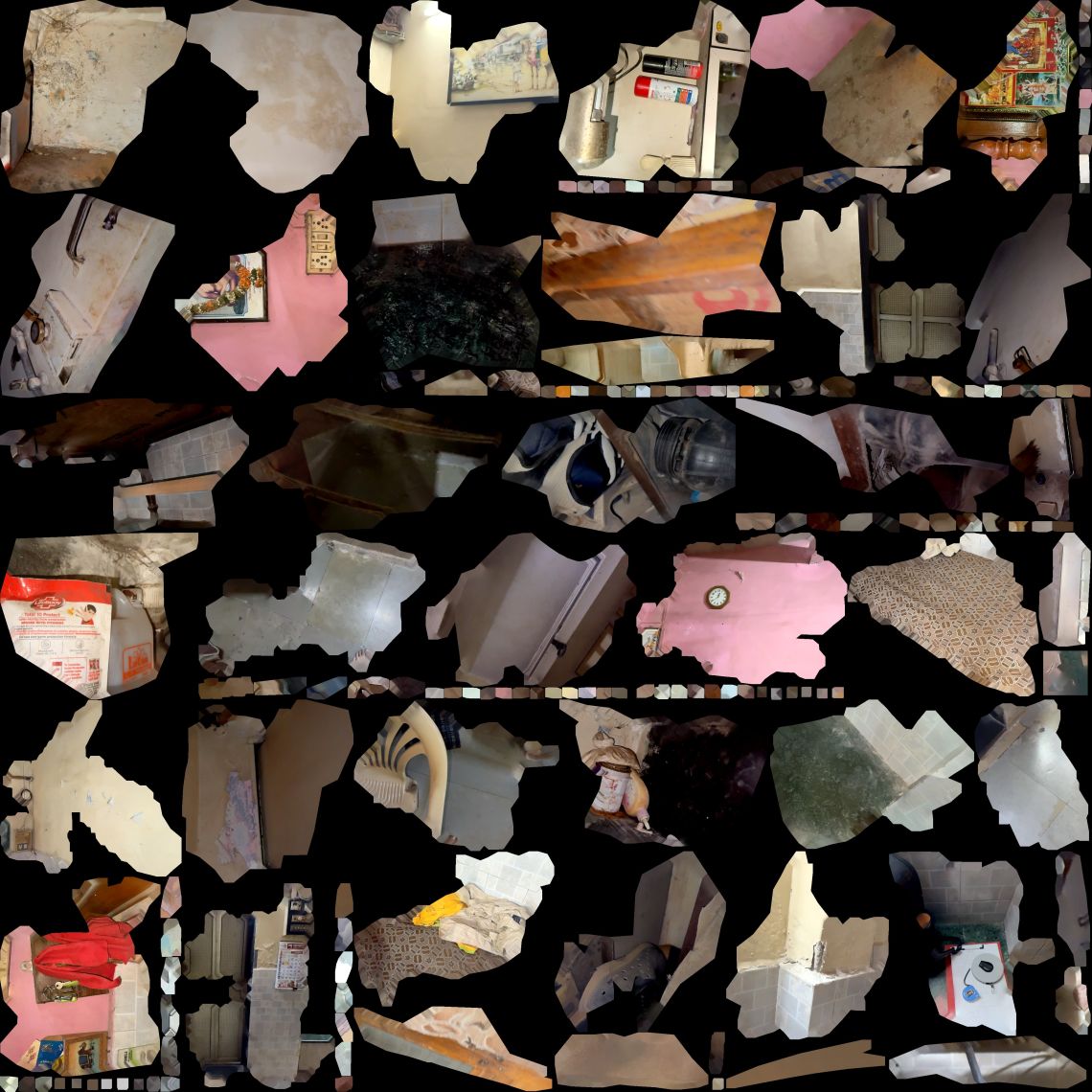
Over the next few weeks, we went back and forth between the site and the computer, piecing together a smorgasbord made of individually scanned rooms. We were often amazed by the assembly and by how the software interpreted millions of these meshes, though often imperfectly. And even then, we struggled to generate orthographic drawings from these meshes. Unfortunately, the Rhino software we’d been using would pick up on half-drawn curtains, irregular plastering, and shelves that covered the corners of walls. The process was iterative: Draw a version of a plan, measure again, come back, and redraw.
More recently, we’ve been working on another project, a much larger set of houses. We definitely took away many learnings from this first project. We also aim to develop an early framework and methodology to document spaces like these that don’t necessarily conform to conventional architectural ideas. Meanwhile, we also hope to document our deliberations on the implications of this documentation process. Stay tuned for more!
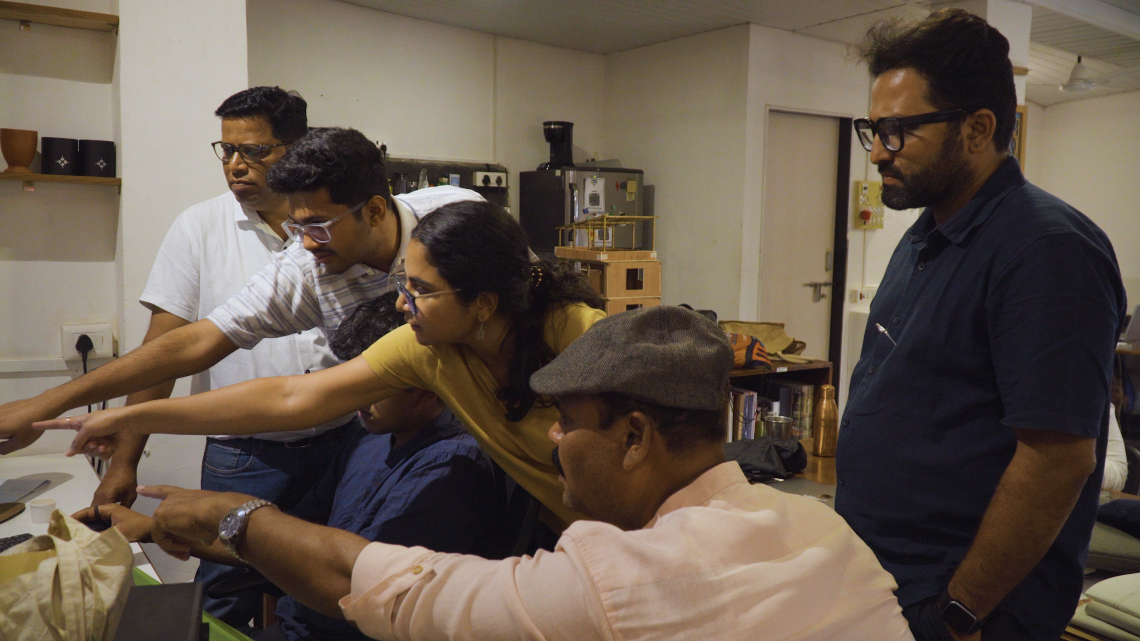
People involved


Related articles

Satish Dalvi, a second-generation Dharavi resident whose journey from sanitation work to caregiving exposes the layered realities of caste, labor, and survival in Mumbai. As an outspoken activist and rationalist, his quiet rebellion against exploitation and superstition carves space for dignity and resistance in the city.


NeuLand is a community garden in Cologne: a successful urban farming project in need of attracting a larger community, especially since its recent re-location to a new site. The six GDI students (Jonas, Kryzsztof, Vanessa, Stanley, Momodo, Beilei) who worked on NeuLand paid a lot of attention to the idea of circularity at every level of their engagement. Inspired by the circularity of seasons and agriculture, and by the uniqueness of the “round table” – around which exchange and interaction happen in a more dynamic form than elsewhere –, they saw the potential for the garden as a centering space in its neighborhood, that invites everyone in.

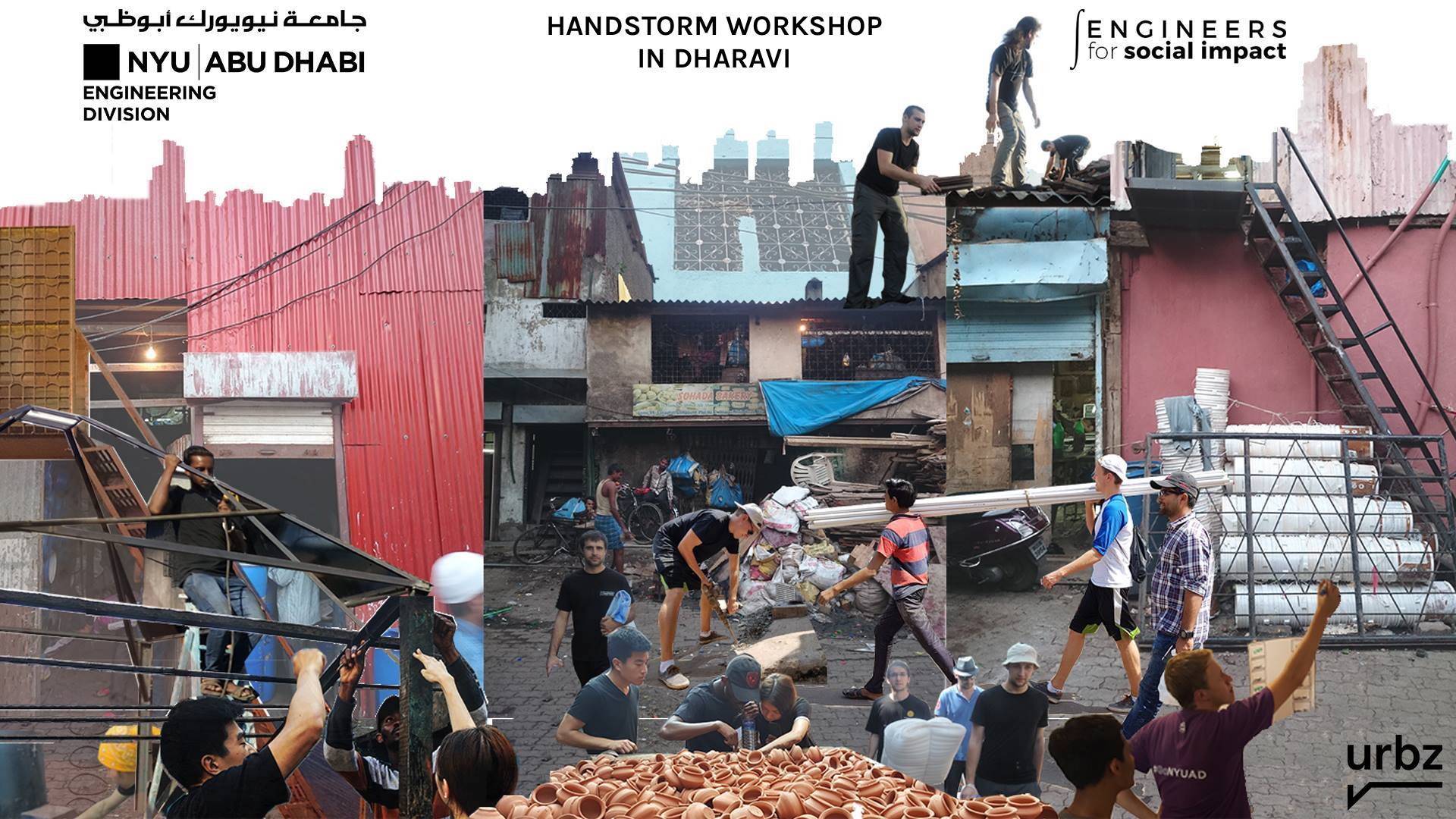
Since 2016, students of the Engineers for Social Impact studio at NYU AD (New York University's campus in Abu Dhabi) have spent one week handstorming in Dharavi, Mumbai. The idea is to research, observe, ideate and handstorm during the week-long workshop, the learning of which are further researched and developed in the studio upon their return to Abu Dhabi. These annual Handstorm workshops in Dharavi generate incremental innovations that improve the quality of life in this massive settlement.









An interview with Liron Shalit, our filmmaker-in-residence. He is an award-winning documentary filmmaker focused on social issues, human rights, and ethical urbanism. Recently, the urbz office hosted a screening of his film Living Euljiro that traces the neglected losses of those living within a centuries-old district of maze-like alleys at the heart of Seoul (Synopsis). We speak to him about his craft, his lessons from Euljiro, and his time here in Dharavi.

It is commonplace in Brazil that ‘favelas’ are a pervasive part of the urban landscape. Recently however, alternative, bottom-up models have emerged that slowly change this scenario.
Ahmedabad in the race of developing cities of India where inspite large availability of land the property prices are shooting up.


Based on a multi-year research with the Mobile Lives Forum on the linkages between Mumbai and Konkan villages this essay, first published in the magazine FuturArc, describes an Indian model of urbanization.

More than a third of Bogota, the capital of Colombia, is estimated to be self-built by the inhabitants, mainly in the periphery of the city. In this article, we learn from Andrés Sánchez of urbz Colombia about the emerging forms of organisation and constant transformation in these self-built neighborhoods.


Pushpa has been living in Dharavi since she was born. Our day starts with her bright smile as she sells pulses right outside the urbz office. We recently had a little chat with her.