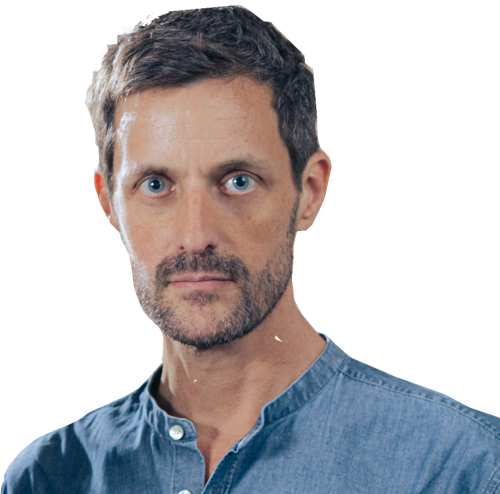
Matias Echanove is Swiss and Spanish urbanologist with over 20 years of research and practice in Asia, America and Europe. He lived, studied and worked in London, New York, Tokyo, and Mumbai, where he co-founded urbz, together with Rahul Srivastava and Geeta Mehta.
His academic training in government and economics at London School of Economics, urban planning at Columbia University, and urban information systems at the University of Tokyo, along with his personal and professional engagement with neighborhoods such as Bed-Stuy in Brooklyn NY, Shimokitazawa in Tokyo or Dharavi in Mumbai have largely contributed to shape urbz’ current practice.
Matias currently lives in his native city of Geneva, where he co-directs urbz Switzerland. He is also co-director at urbz Paris and an active partner at urbz’ offices in Mumbai and Bogota. He leads or coordinates projects in each of these countries, which involves spending too much time on Zoom calls and plane flights. Matias recently fell in love with the city of Cali in Colombia, where urbz works on the development of participatory tools and methodologies at the scale of the city. In Geneva, he works on the landscaping of a park for the International Federation of the Red Cross, among other projects. He is also currently involved in the reprogramming of a massive hospital complex in Nantes; and an improvement plan for a fisherman’s village in the heart of Mumbai.
Matias Echanove is regularly invited to present his work at institutions such as Harvard, Columbia, Berkeley, Princeton, ETHZ, EPFL, Strelka Institute, Max Planck Institute, the World Bank, the Swiss Architecture Museum in Basel, and Urban Age. He has written a large number of articles and opinion pieces in journals such as The New York Times, The Hindu, The Guardian, The Wall Street Journal, Art India, Oxford University Press, Strelka Press (Moscow), Domus (Milan), Tokyo University Press, and The Indian Architect and Builder. He was also interviewed on urban issues in the New York Times and The Economist. Together with Rahul Srivastava, he is currently writing a book on Homegrown Cities that will be published by Verso in 2026.
His work with urbz was exhibited at MoMA in New York, MAXXI in Rome, MAK in Vienna, Istanbul Design Biennial, Chicago Architecture Biennial, São Paulo Cultural Center, and Bhau Daji Lad City Museum in Mumbai, among other places.
Matias Echanove and Rahul Srivastava are Ambassador of Swiss-Indian friendship, an award given in 2017 by Swiss President Doris Leuthard and Indian Minister for Road Transport and Highways Mr. Mansukh L. Mandaviya for contributing innovative ideas in urban planning, and for strengthening the Swiss-Indian relationship.



Articles
URBZ Chile present Citycamp!!!
urbz Chile presents Citycamp (Only proceed if you can read and understand Spanish)

Infusing and Confusing India's Urbanness
What began as a regular jostling and tugging of the idea in a brainstorm soon took off as an imaginative exercise that encouraged creative and personal readings of the concept and the making of its visual expressions.

Mumbai's Kinetic Exhaustion
What does the mutation of colonial Bombay into global Mumbai mean for architectural forms and public life?

The Village Outside
Behind the famed Renaissance hotel by the Powai lake is a small, homegrown village called Paspoli which is home to the workforce of the hotel.

Warli in Dharavi
While Warli art has become as gentrified as an art gallery in a heritage urban precinct, the reality it represents is hugely significant.

Update on Shivaji Nagar's Masjid Project
The new mosque will be built on the site of a 30 years old mosque nestled in the dense middle section of the neighbourhood.
The Homegrown Cities Project
How local, community owned and managed housing co-operatives, can be a vital step towards improving the neighbourhoods, bringing good quality civic infrastructure and making the city genuinely ’slum-free’.
Designing from Something (When Tabula Rasa is Not an Option)
The tool-house as starting point for designers to learn from local skills, practices and aspirations.

Complex is Beautiful
In Rio “pacification” is a code word to describe the invasion of neighborhoods by squads of policemen walking around their guns pulled out, ready to shoot.

Shivaji Nagar M Ward
While residents may live here and work elsewhere, this neighbourhood also shows a high level of its own economic activities.