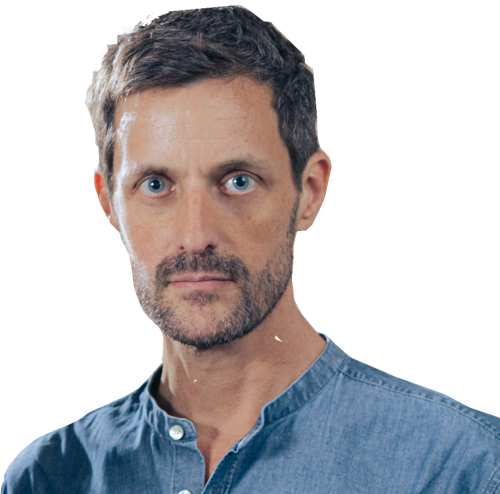
Matias Echanove is Swiss and Spanish urbanologist with over 20 years of research and practice in Asia, America and Europe. He lived, studied and worked in London, New York, Tokyo, and Mumbai, where he co-founded urbz, together with Rahul Srivastava and Geeta Mehta.
His academic training in government and economics at London School of Economics, urban planning at Columbia University, and urban information systems at the University of Tokyo, along with his personal and professional engagement with neighborhoods such as Bed-Stuy in Brooklyn NY, Shimokitazawa in Tokyo or Dharavi in Mumbai have largely contributed to shape urbz’ current practice.
Matias currently lives in his native city of Geneva, where he co-directs urbz Switzerland. He is also co-director at urbz Paris and an active partner at urbz’ offices in Mumbai and Bogota. He leads or coordinates projects in each of these countries, which involves spending too much time on Zoom calls and plane flights. Matias recently fell in love with the city of Cali in Colombia, where urbz works on the development of participatory tools and methodologies at the scale of the city. In Geneva, he works on the landscaping of a park for the International Federation of the Red Cross, among other projects. He is also currently involved in the reprogramming of a massive hospital complex in Nantes; and an improvement plan for a fisherman’s village in the heart of Mumbai.
Matias Echanove is regularly invited to present his work at institutions such as Harvard, Columbia, Berkeley, Princeton, ETHZ, EPFL, Strelka Institute, Max Planck Institute, the World Bank, the Swiss Architecture Museum in Basel, and Urban Age. He has written a large number of articles and opinion pieces in journals such as The New York Times, The Hindu, The Guardian, The Wall Street Journal, Art India, Oxford University Press, Strelka Press (Moscow), Domus (Milan), Tokyo University Press, and The Indian Architect and Builder. He was also interviewed on urban issues in the New York Times and The Economist. Together with Rahul Srivastava, he is currently writing a book on Homegrown Cities that will be published by Verso in 2026.
His work with urbz was exhibited at MoMA in New York, MAXXI in Rome, MAK in Vienna, Istanbul Design Biennial, Chicago Architecture Biennial, São Paulo Cultural Center, and Bhau Daji Lad City Museum in Mumbai, among other places.
Matias Echanove and Rahul Srivastava are Ambassador of Swiss-Indian friendship, an award given in 2017 by Swiss President Doris Leuthard and Indian Minister for Road Transport and Highways Mr. Mansukh L. Mandaviya for contributing innovative ideas in urban planning, and for strengthening the Swiss-Indian relationship.



Articles
Hamburg: between the medieval and the global
The organisation of the G20 reflects its democratic deficit. Not only did the G20 summit turn parts of Hamburg into a virtual fortress, it also made hostages of thousands of peaceful protesters and residents. (The Hindu, 16.07.17)

Accommodating an Indigenous History
India’s financial capital does infantilise its own indigenous history. But it also celebrates the past.

Why Mumbai extends far beyond its metropolitan limits
Transcript of interview in the Hindustan Times.

More smart, less city
Reviewing Sondgo and its functioning residential and work places, thirteen years after the initial plans were drafted. (The Hindu, 19.06.17)

Goa's Homegrown Commons
Privatisation, if seen as an exclusive way to regularise settlements, increases the risk of political manipulation and real-estate speculation. (The Hindu, 29.03.17)

Culture for a World in Flux
How global cities can reinvent themselves by going local. (The Hindu, 03.05.17)

A Thousand Plateaus
A community struggling with water and identity finds hope in nature and culture. (The Hindu, 11.04.17)

‘Our lives are 50-50’
With one foot in the village and the other in the city, migrants have done more to urbanise India than any development scheme (The Hindu, 12.03.17)

Whatsapp Dharavi?
This is the first of our fortnightly column in The Hindu Sunday Magazine. This week we explore how the rapid absorption of smart technologies is transforming how business is done in Dharavi and all over India. (The Hindu, 26.02.17)
Soap
Producing clothes in high quantity is one thing, washing them all is another. An insight into Mumbai's famous Dhobi Ghat.